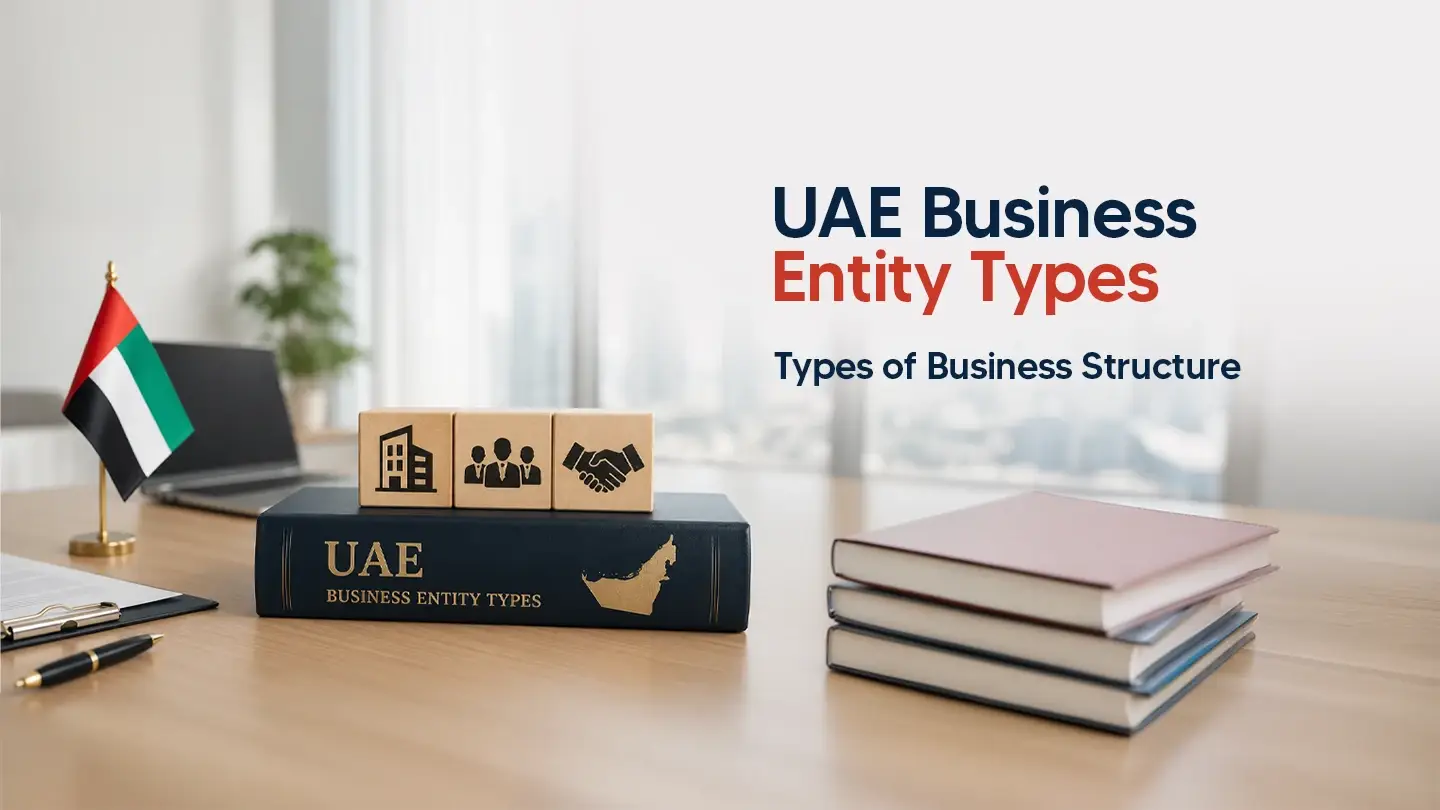
Choosing a legal structure is the first real decision you’ll make as a founder in the UAE and it shapes almost everything that follows: how much of the business you own, where you can operate, how you’re taxed, and how exposed your personal assets are if things go wrong. With so many UAE Business Entity Types on offer, from a mainland LLC to a free zone FZCO to a straightforward branch office, it’s easy to default to whatever a friend used, or whatever came up first on Google.
This guide breaks down every major UAE business entity types in plain English, compares them side by side, and walks you through how to actually pick the right one for 2026.
Why the Right Business Structure Matters
Every legal uae business entity type comes with its own rules on foreign ownership, minimum shareholders, liability protection, permitted business activities, and where you’re allowed to trade. Get this decision right, and your company setup is smooth, your bank account opens without friction, and your tax position is clean. Get it wrong, and you could end up restructuring later — an expensive, time-consuming process that most founders would rather avoid.
The UAE’s Federal Decree-Law No. 32 of 2021 (the Commercial Companies Law) governs most mainland structures, while each free zone runs its own companies regulations for entities registered within it. Since the 2021 reforms, 100% foreign ownership is now available for the vast majority of commercial and industrial activities on the mainland, a major shift from the old 51% local sponsor requirement, which still applies only to a short list of strategic sectors.
Types of Business Entities in the UAE
1. Limited Liability Company (LLC)
An Limited Liability Company is the most common structure for businesses trading directly with the UAE mainland market. It can be formed by one to fifty shareholders, and liability is capped at each shareholder’s capital contribution. Since the 2021 amendments, most commercial and industrial activities allow full foreign ownership, though a limited set of strategic sectors – defense and some oil and gas activities among them, still require Emirati participation.
An LLC can appoint up to five managers and is free to trade anywhere in the UAE and internationally, making it the default choice for retail, trading, and service businesses that want a local footprint.
2. Free Zone Establishment (FZE)
An Free Zone Establishment (FZE) is a single-shareholder company registered inside one of the UAE’s 40+ free zones (think DMCC, IFZA, JAFZA, or RAKEZ). It offers 100% foreign ownership, full profit repatriation, and – depending on the zone and activity – potential access to the UAE’s 0% Qualifying Free Zone Person corporate tax regime on qualifying income. The trade-off: an FZE generally can’t sell directly into the mainland market without working through a distributor or local service agent.
3. Free Zone Company (FZCO)
An FZCO is essentially the multi-shareholder version of an FZE, supporting anywhere from two up to fifty shareholders. It carries the same free zone advantages – full foreign ownership, streamlined licensing, and capital-limited liability and is the natural choice for founders going into business with partners or co-investors rather than flying solo.
4. Branch of a Foreign Company
A branch office lets an existing international company operate in the UAE without incorporating a separate legal entity. It carries out the same activities as its parent and trades under the parent’s name, but it isn’t a distinct legal person – the parent company remains fully liable for the branch’s obligations. Branches can be set up on the mainland or within a free zone and typically need a National Service Agent (mainland) or the relevant free zone authority’s approval to register.
5. Representative Office
Often confused with a branch, a representative office is far more restricted. It exists purely to promote the parent company, conduct market research, and liaise with local contacts, it cannot invoice, sign commercial contracts, or generate revenue in the UAE. Think of it as a marketing outpost rather than an operating business, and a low-risk way for a foreign company to test the market before committing further.
6. Sole Establishment
A sole establishment is owned entirely by one individual, who retains full control and full personal liability – there’s no legal separation between the owner and the business. It’s popular with freelancers and consultants for its simplicity and low setup cost, though certain regulated or mainland activities still require a local service agent.
7. Civil Company
Reserved for licensed professionals – lawyers, doctors, engineers, accountants, and similar consultancy fields, a civil company is governed by the UAE Civil Code rather than the Commercial Companies Law. It requires two or more partners, each of whom carries personal liability for their own professional conduct, and typically needs a National Service Agent if any partner is a foreign national.
8. Offshore Company
Offshore companies (registered through jurisdictions like JAFZA Offshore, RAK ICC, or Ajman Offshore) are built for holding assets, international trading, and wealth structuring rather than operating inside the UAE. They offer 100% foreign ownership and confidentiality benefits, but can’t lease UAE office space, sponsor visas, or trade with the local market – they exist purely as a holding or invoicing vehicle.
9. Public and Private Joint Stock Companies (PJSC/PrJSC)
These share-capital like joint venture companies structures suit businesses planning to raise significant institutional or public capital. A PJSC requires a minimum of five founders and can list shares on a stock exchange; a PrJSC needs at least two founders but keeps its shares privately held. Both cap shareholder liability to the shares they hold, making them the go-to structure for larger, capital-intensive ventures.
UAE Company Types Comparison
Here’s a side-by-side view of how the main legal UAE business entity types stack up on the factors that matter most when you’re deciding how to incorporate.
| Entity Type | Ownership | Liability | Min. Shareholders | Can Trade in UAE Mainland? | Best Suited For |
| Mainland LLC | Up to 100% foreign ownership in most activities | Limited to capital | 1–50 | Yes, directly | Trading, retail, and service businesses targeting the local market |
| FZE (Free Zone Establishment) | 100% foreign ownership | Limited to capital | 1 | Only via a distributor/local agent | Solo founders in a free zone |
| FZCO (Free Zone Company) | 100% foreign ownership | Limited to capital | 2–50 | Only via a distributor/local agent | Multi-partner free zone businesses |
| Branch of a Foreign Company | 100% parent-owned | Unlimited (parent liable) | N/A (extension) | Yes, same activity as parent | Established firms expanding their UAE presence |
| Representative Office | 100% parent-owned | Unlimited (parent liable) | N/A (extension) | No sales/contracts | Market research and brand promotion only |
| Sole Establishment | 100% single owner | Unlimited | 1 | Yes | Freelancers, consultants, and small owner-run ventures |
| Civil Company | 100% professional partners | Unlimited (per partner) | 2+ | Yes (regulated professions) | Law, medical, accounting, and consultancy partnerships |
| Offshore Company | 100% foreign ownership | Limited to capital | 1–50 | No local trading | Holding assets, international trade, and wealth structuring |
| Public/Private Joint Stock Company | Shareholder-based | Limited to shares held | PJSC: 5+ PrJSC: 2+ | Yes | Large-scale capital raising and institutional ventures |
Business Ownership Models: Mainland vs Free Zone vs Offshore
Beyond the specific entity type, most founders are really choosing between three broader jurisdictions, each with its own ownership model and trade-offs:
| Factor | What It Means for You |
| Mainland | Licensed by the Department of Economy and Tourism (or equivalent) in each emirate. Provides full access to the local market and government contracts, with most activities now open to 100% foreign ownership. |
| Free Zone | Licensed by an individual free zone authority. Best for export-focused, tech, or professional services businesses. Offers 100% foreign ownership as standard, but mainland trading requires a distributor or dual-licence setup. |
| Offshore | No physical UAE operations permitted. Ideal for holding companies, international trading structures, and asset protection rather than day-to-day trading. |
How to Choose the Right Business Structure in UAE
A few practical questions can narrow the field quickly:
- Where will you actually sell? Mainland-facing sales point toward an LLC; export or international clients suit a free zone FZE/FZCO.
- How many owners are involved? Solo founders can use an FZE or sole establishment; partners need an FZCO, LLC, or civil company.
- Are you a licensed professional? Regulated fields like law, medicine, or engineering typically require a civil company rather than a standard commercial licence.
- Do you need a UAE office and visas, or just a holding vehicle? If it’s the latter, an offshore company may be more cost-effective than a full operating entity.
- Are you extending an existing international business? A branch keeps you tied to your parent company’s track record and contracts; a new local entity gives you a clean UAE legal identity.
There’s no single ‘best’ structure – only the one that matches your ownership goals, activity list, and where your customers actually are. Getting professional guidance before you file paperwork is almost always cheaper than restructuring afterward.
Get the Right Structure from Day One
Every business is different, and the ‘right’ entity type depends on your ownership goals, your target market, and your growth plans over the next few years – not just what’s cheapest to set up today. Shuraa Business Setup has helped thousands of entrepreneurs incorporate across the UAE’s mainland and free zones, matching each one to a structure that fits their activity, ownership needs, and long-term plans.
If you’re weighing up an LLC against an FZCO, or wondering whether a branch or a fresh incorporation makes more sense, our team can walk you through the options and handle the paperwork end to end.
Frequently Asked Questions
1. What is the difference between FZE and FZCO?
An FZE has a single shareholder, while an FZCO supports two or more (up to fifty in most zones). Both offer the same 100% foreign ownership and free zone benefits – the choice comes down to how many owners are involved.
2. Can a free zone company trade on the UAE mainland?
Not directly. A free zone entity typically needs to work through a distributor, appoint a mainland service agent, or obtain a dual licence to sell into the mainland market.
3. Do I need a local sponsor for a mainland LLC in 2026?
For most commercial and industrial activities, no – 100% foreign ownership has been permitted since the 2021 reforms. A local Emirati partner is still required for a short list of strategic activities, such as certain defense-related and oil and gas sectors.
4. What’s the difference between a branch and a representative office?
A branch can trade, invoice, and sign contracts under its parent company’s licence. A representative office cannot – it’s limited to marketing, liaison, and market research activities and generates no local revenue.
5. Which UAE business structure has the least personal liability risk?
LLCs, FZEs, FZCOs, offshore companies, and joint stock companies all cap liability at the shareholder’s capital contribution. Sole establishments and civil companies carry unlimited personal liability for their owners or partners.
6. Is an offshore company the same as a free zone company?
No. A free zone company (FZE/FZCO) can lease office space, sponsor employee visas, and operate physically within its zone. An offshore company cannot do any of this, it exists purely as a holding or international trading vehicle with no UAE operating presence.