
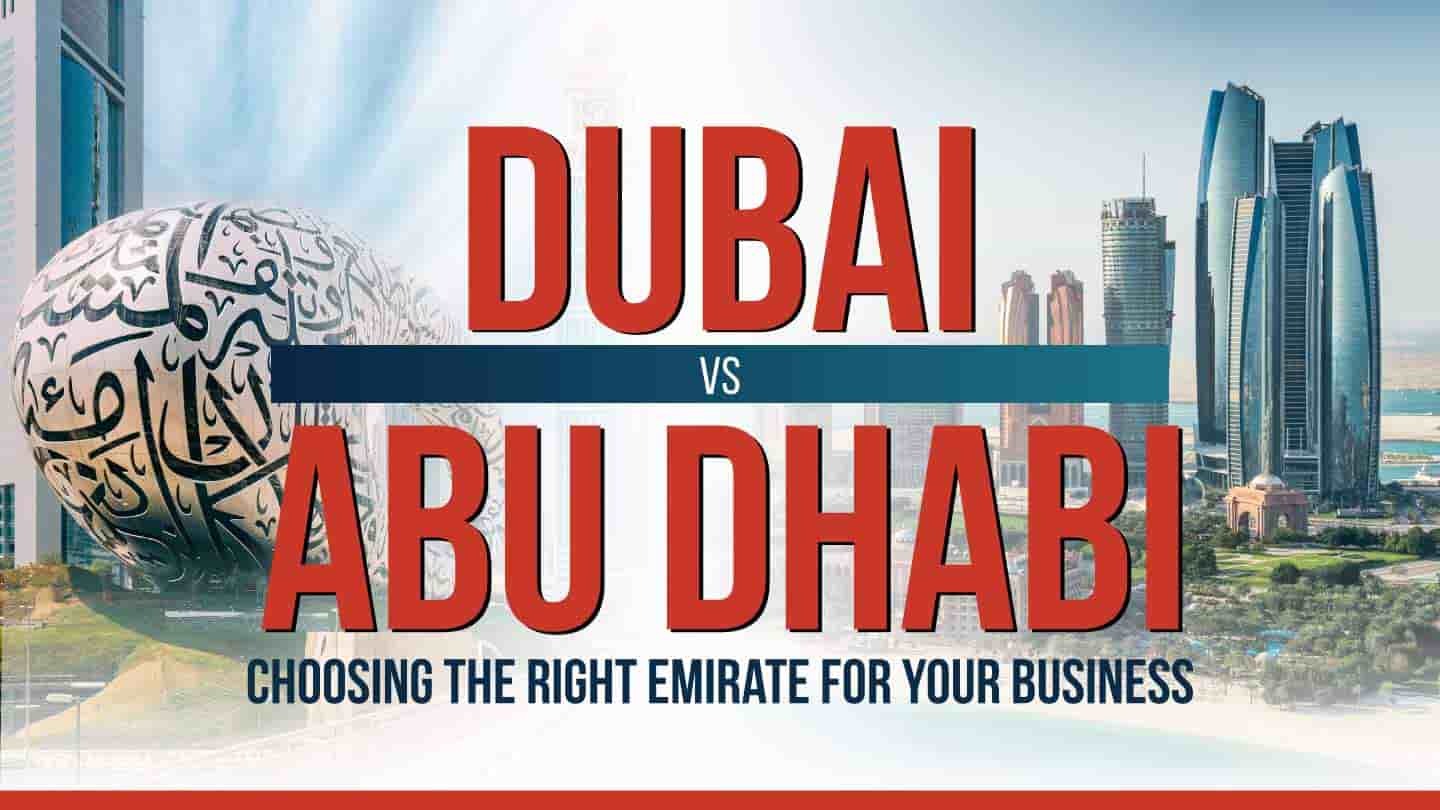
The first and most important strategic decision for your UAE business is choosing between Dubai vs. Abu Dhabi. It is not about which city is superior, but which powerhouse is the perfect engine for your specific ambition. This choice will dictate your market access, operational costs, regulatory pathway, and growth trajectory from day one.
Dubai operates as the world’s hyper-connected commercial hub, a launchpad for startups and global brands into high-growth markets. Abu Dhabi, the capital, is the bedrock of long-term stability, offering sovereign-backed scale for industrial and strategic ventures. With over 26 years of experience guiding more than 100,000 businesses, Shuraa Business Setup provides the expert framework in this guide to cut through the clutter. We will equip you with the insights to make a confident, strategic choice for your company’s long-term home.
Two Economic Powerhouses, One Strategic Choice
Understanding the core economic drivers of each emirate is essential to aligning your business with the right ecosystem.
Dubai: The Diversified Global Nexus
Dubai is a masterclass in economic diversification, with oil contributing less than 1% to its GDP. A nominal GDP of approximately $138 billion is driven by trade, tourism, logistics, real estate, and financial services. This private-sector-led model creates a dynamic, fast-paced environment. Dubai’s genius lies in its connectivity: positioned within an 8-hour flight radius of most major economies, it operates as a gateway for East-West trade and innovation.
Abu Dhabi: The Capital of Scale and Stability
Abu Dhabi, the capital of the UAE and the largest contributor to the national GDP, stands out for its scale and long-term stability. While rooted in substantial hydrocarbon resources, a strategic vision has successfully diversified its economy. Today, non-oil sectors contribute over 50% of GDP, driven by government-led investments in manufacturing, renewable energy, aerospace, and advanced technology. This translates to a market of major projects, significant capital, and strategic partnerships.
The Modern UAE Business Landscape: Clarity and Access
Navigating the UAE’s business setup requires understanding the established legal framework, which offers unparalleled advantages for foreign investors.
- 100% Foreign Ownership is the Standard: The requirement for a local majority partner has been removed. Full foreign ownership is now permitted for most commercial and professional activities on the mainland and in all free zones, granting you complete operational and profit control.
- Seamless Market Access for Free Zone Companies: The historical barrier between free zones and the mainland market is gone. Companies can now legally serve the entire UAE through a Department of Economy and Tourism (DET) permit, by establishing a mainland branch, or via a Dual License from select zones.
- A Competitive and Transparent Tax Regime: The UAE offers a 0% tax on personal income and a competitive federal corporate tax. The standard rate is 9% if taxable profits exceed AED 375,000. Crucially, Qualifying Free Zone Persons can benefit from a 0% corporate tax rate on qualifying income, creating powerful structures for international business.
Dubai vs. Abu Dhabi: Your Strategic Decision Framework
This comparative framework, enhanced with Shuraa’s expert insights, is designed to guide your choice beyond superficial advantages.
| Decision Factor | Dubai: The Global Commercial Hub | Abu Dhabi: The Strategic Capital | The Shuraa Insight |
|---|---|---|---|
| Core Economic Engine | Highly diversified; driven by trade, tourism, logistics, real estate, finance. Oil is <1% of GDP. | Largest UAE economy; diversified but with strong roots in oil, energy, manufacturing, and aerospace. | Dubai offers agility and market velocity. Abu Dhabi offers scale and sovereign-backed stability. |
| Ideal Business Profile | Startups, SMEs, trading firms, international HQs, service-based industries (tech, media, consulting, retail). | Large-scale industrial projects, energy & renewables, defense, healthcare, businesses seeking government partnerships. | Match your industry to the emirate’s strategic priorities for optimal support and incentives. |
| Regulatory & Setup Environment | Fast-paced and flexible, particularly in over 40 specialized free zones. Speedy setup is a hallmark. | Structured, policy-driven, and meticulous. Offers immense long-term stability for large investments. | Dubai is built for speed to market. Abu Dhabi is built for enduring, scaled operations. |
| Market Access & Logistics | Unrivalled global connectivity (ports, airports). A gateway for East-West trade and e-commerce. | Direct access to federal government contracts and major regional industrial supply chains. | Where are your primary customers, suppliers, and partners located? |
| Free Zone Specialization | DMCC (commodities trade), DIFC (finance), Dubai Internet City (tech), Dubai Media City. | ADGM (global finance & fintech), KIZAD (industrial logistics), Masdar City (clean tech). | Both offer 100% ownership. The choice is about which specialized ecosystem fits your industry. |
| Operational Cost Reality | Generally higher for premium office space, visas, and marketing. The price for global visibility. | Typically 15-30% lower for comparable commercial rent and living costs. Cost-efficient for scaling. | Model your 5-year financial plan. The higher cost in Dubai is an investment in unparalleled access. |
| Final Strategic Verdict | Choose Dubai if your success depends on global branding, rapid networking, and a fast-paced, private-sector-led ecosystem. | Choose Abu Dhabi if your venture is capital-intensive, benefits from government incentives, and prioritizes long-term, stable growth. | This is a foundational strategic decision. The right choice unlocks growth; the wrong one creates friction. |
Business Setup Costs: Dubai Vs. Abu Dhabi
A transparent understanding of costs and the tax regime is vital for planning.
Understanding Setup Costs
Initial investments vary based on jurisdiction, license type, and visa needs. As a guide:
- Dubai: Total setup costs typically range from AED 15,000* to AED 50,000*+, influenced by premium free zone locations or mainland approvals.
- Abu Dhabi: Often more cost-effective, with total setup for a mainland company frequently between AED 15,000* and AED 25,000*.
These costs generally encompass trade license fees, registered office/agent fees, and government charges.
Shuraa’s Proven Insight: The marginally higher cost of a specialized free zone is often your best initial investment. You’re paying for an ecosystem, industry-specific networking, talent pipelines, and regulatory support, not just a license.
Beyond the Checklist: Insights from 100,000+ Client Journeys
Beyond the data, successful market entry relies on nuanced understanding. Based on our extensive client portfolio, we advise:
- Plan for Your Future Self: A tech startup might launch in Dubai Internet City but later establish an Abu Dhabi branch in Hub71 to tap into different grant and funding networks. Structure for flexibility.
- The “Local Service Agent” serves as a facilitator rather than a partner. For mainland professional licenses (consultants, architects), an LSA is required. This position is a streamlined administrative role with no ownership stake or profit share.
- Your Banking Strategy is Key: Location can influence banking options. Dubai’s vast network of international and local banks is ideal for multi-currency trade, while Abu Dhabi can offer strong relationships for large-scale project finance.
Your Next Steps: From Decision to Launch
Follow this logical pathway to translate analysis into action:
- Define Your Core Activity: Be specific about your primary business (e.g., “software development for logistics”, not just “technology”).
- Identify Your Primary Market: Are you exporting globally, serving the UAE mainland, or targeting government tenders?
- Apply the Framework: Use the table above to shortlist your emirate and preferred jurisdiction (e.g., Mainland Dubai vs. ADGM in Abu Dhabi).
- Engage Expert Execution: Partner with a trusted market entry specialist to navigate licensing, banking, and visas without costly delays.
The choice between Dubai and Abu Dhabi is the first test of your venture’s strategic clarity. With the right partner, it becomes a straightforward step toward a successful launch.
Are you prepared to put this analysis into practice? The Shuraa team can analyse your specific business model, target market, and growth plan to recommend the optimal jurisdiction and manage your entire setup process. Contact Shuraa Business Setup for a Free Consultation.
Further Reading on Shuraa
- Mainland vs Free Zone in the UAE: Your Complete 2026 Comparison
- The 10-Step Checklist After Company Registration in Dubai
- How to Start a Business in Dubai: Step-by-Step Guide
- How to Start a Business in Abu Dhabi
- Corporate Tax in the UAE – Understanding the Tax System
Frequently Asked Questions (FAQs)
1. Which is better for business: Dubai or Abu Dhabi?
There is no universal “better”—it depends on your business model. Dubai is the undisputed hub for global trade, tourism, startups, and fast-paced service industries. Abu Dhabi is the strategic capital ideal for long-term, large-scale investments in sectors like energy, aerospace, and government projects, offering greater cost efficiency and stability. The best choice aligns with your industry, target market, and growth timeline.
2. Is it cheaper to set up a business in Abu Dhabi than Dubai?
Yes, in most cases. Abu Dhabi typically offers lower commercial rents, warehousing costs, and overall operational expenses. Dubai involves a premium for its global brand visibility and market access. For cost-conscious businesses planning to scale, Abu Dhabi often provides a more efficient cost base.
3. Do both emirates allow 100% foreign ownership?
Yes. Following UAE federal law reform, 100% foreign ownership is permitted for most business activities on the mainland and in all free zones across both emirates. This is now the standard, not an exception, giving you full control.
4. Can my Dubai free zone company do business on the UAE mainland?
Yes, absolutely. Regulations now provide clear pathways. Your free zone company can obtain a permit from the Department of Economy and Tourism (DET) to operate on the mainland, establish a branch office, or, in some cases, hold a dual license for full market access.
5. Dubai or Abu Dhabi for startups?
Dubai has a denser ecosystem for general startups (e.g., e-commerce, tech services) with numerous incubators and investors. However, Abu Dhabi is a powerhouse for specialised startups in fintech (via ADGM) and clean energy/deep tech (via Hub71), offering substantial government grants and R&D partnerships. Your startup’s sector dictates the best fit.
6. Are corporate tax rules different in Dubai and Abu Dhabi?
No. Both follow the UAE’s federal corporate tax regime: a 9% rate on taxable profits above AED 375,000. The key advantage in both emirates is for Qualifying Free Zone Persons, who can benefit from a 0% tax rate on qualifying income, making free zones in either location powerful for international business.
7. How can a business setup consultant help me choose?
Professional consultants, like Shuraa Business Setup, analyse your specific business activity, financial model, and growth plan against the nuanced realities of each emirate’s licensing, incentives, and ecosystem. We provide a data-backed recommendation and handle the entire setup process, ensuring you make an optimal choice and launch efficiently.
Disclaimer: The information provided in this guide is for general informational purposes only and does not constitute legal, financial, or professional advice. While we strive to ensure accuracy, UAE regulations and policies are subject to change. It is strongly recommended that you consult qualified professionals, such as Shuraa Business Setup, for advice tailored to your specific business circumstances before making any decisions. We do not accept liability for any actions taken based on the content of this article.