
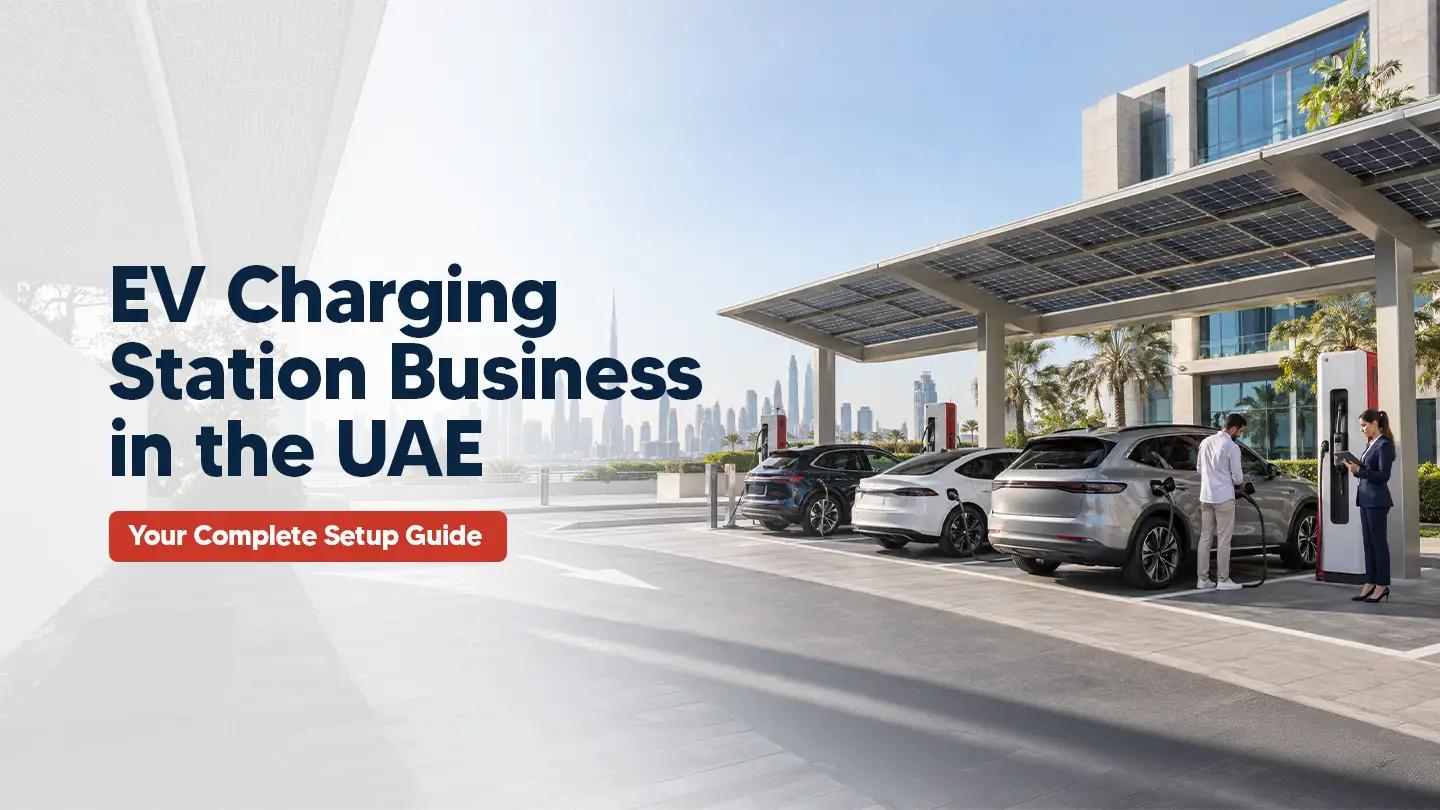
The UAE is rapidly moving toward cleaner, smarter mobility, creating new opportunities for entrepreneurs looking to enter the electric vehicle ecosystem. As electric vehicle adoption grows across Dubai and other emirates, the need for accessible, reliable and strategically located charging infrastructure is growing alongside it.
This makes the EV charging station business opportunity in the UAE worth exploring investors, technology companies, infrastructure providers, and entrepreneurs.
However, setting up an EV charging station business involves more than purchasing chargers and finding a parking space. Depending on your business model and location, you may need a suitable business licence, utility approvals, technical permissions, site-owner agreements, and other regulatory clearances.
If you are wondering how to open an electric car charging station in the UAE, this guide explains the key steps, licensing considerations, DEWA requirements, infrastructure needs, and business models you should understand before getting started.
Why Start an EV Charging Station Business in the UAE?
The UAE has been actively developing its electric mobility infrastructure as part of its wider sustainability and smart-mobility goals.
Dubai has established a growing EV charging ecosystem through DEWA’s Green Charger initiative. DEWA reported that Dubai had more than 47,900 EVs by the end of 2025 and over 1,860 charging points across the emirate, including charging infrastructure developed through partnerships with government and private-sector entities.
For entrepreneurs, this creates opportunities across several areas, including:
- Openbare EV-laadstations
- Workplace and commercial charging
- Residential-community charging
- Fleet and logistics charging
- Charging stations for hotels, malls and retail destinations
- EV charger sales and installation
- Charging-management software and digital platforms
- Charging-as-a-service solutions
What Is an EV Charging Station Business?
An EV charging station business can take several forms.
You could operate your own network of charging stations and generate revenue from charging sessions. Alternatively, you could supply and install charging equipment for property owners, develop software for charging networks, or provide charging infrastructure as a service.
Some of the common business models include:
Public Charging Station Operator
Under this model, your company owns or operates charging stations and allows EV owners to pay for charging. Revenue can come from charging sessions, subscriptions, fleet agreements, or partnerships with property owners.
EV Charger Supplier and Installer
Instead of operating the stations yourself, you can import, distribute or sell EV charging equipment and provide installation and maintenance services.
This model can target:
- Hotels
- Winkelcentra
- Kantoren
- Residentiële gebouwen
- Benzine stations
- Wagenparkbeheerders
- Commerciële eigendommen
Opladen als een service
Property owners may want EV charging facilities without investing heavily in the equipment or managing the technology themselves.
A charging company can install and operate the infrastructure while earning through service fees, revenue sharing, or long-term agreements.
EV Charging Software and Platforms
Another route is to build the digital layer behind charging infrastructure. This may include mobile applications, payment systems, station monitoring, customer accounts, and charging-management platforms.
This can be a comparatively asset-light model because the business does not necessarily need to own the physical charging equipment.
Types of EV Chargers for Your Business
The type of charger you choose will influence your investment, electricity requirements, installation costs, and target customers.
AC-opladers
AC chargers are generally suitable for locations where vehicles remain parked for longer periods.
They can work well in:
- Kantoren
- Hotels
- Woongemeenschappen
- werkplaatsen
- Winkelcentra
- Commerciële parkeerterreinen
DEWA’s current public charging infrastructure includes AC wall-box and public chargers, demonstrating the role of AC charging in everyday EV use.
DC-snelladers
DC chargers are designed for faster charging and are more suitable for locations where customers expect shorter charging times.
Mogelijke locaties zijn onder andere:
- Snelwegen
- Benzine stations
- Major commercial areas
- Transportknooppunten
- Vlootdepots
- Dedicated public charging hubs
Because DC systems can require substantially higher electrical capacity, infrastructure planning becomes particularly important before installation.
How to Open an Electric Car Charging Station in the UAE?
If you are planning an EV charging station business, start with the business model rather than the charger itself. Here is a practical roadmap.
Step 1: Decide Your EV Charging Business Model
First, determine exactly what your company will do.
Wil je:
- Own and operate charging stations?
- Sell EV chargers?
- Install and maintain charging equipment?
- Provide charging software?
- Operating a charging network?
- Offer charging-as-a-service?
- Install chargers for your own fleet?
This decision matters because your business activity and licensing requirements should correspond with the services you plan to provide.
For example, a company that only trades electrical equipment may not automatically have the scope to install or operate a commercial charging network.
Step 2: Select the Right Business Activity and Licence
Het juiste kiezen zakelijke activiteit is one of the most important parts of setting up an EV charging station for business UAE.
Depending on the proposed model, activities may fall within areas such as:
- EV oplaadinfrastructuur
- Electrical equipment trading
- Electromechanical works
- Activities under Technical services license
- Installatie en onderhoud
- Software or IT services
The exact combination of activities depends on the nature and scope of your business.
This is where working with an experienced business setup consultant can help. Shuraa Business Setup can assess your proposed EV business model and help identify the appropriate licensing structure before you begin the application process.
Step 3: Choose Mainland or Free Zone
Your preferred operating location is another important consideration.
A vestiging van een bedrijf in een vrije zone can work well for certain businesses such as software companies, holding structures, equipment trading, or businesses operating within a particular free zone.
However, if you plan to install and operate charging stations at mainland locations such as malls, hotels, offices, or public-facing commercial properties, you need to assess the licensing structure carefully.
For an EV charging station business in Dubai, a bedrijfsopstelling op het vasteland may be more suitable if the business needs to operate directly across Dubai’s mainland commercial environment.
Shuraa Business Setup can help you compare mainland and free zone structures based on your planned activities, locations, and operational requirements.
Stap 4: Een geschikte locatie vinden
Location can make or break an EV charging business. A charger in a location with limited EV traffic may generate low utilisation even if the equipment is technically excellent.
Mogelijke locaties zijn onder andere:
- Winkelcentra
- Hotels
- Kantoorgebouwen
- Woongemeenschappen
- supermarkten
- Benzine stations
- Snelwegen
- Parkeermogelijkheden
- Vlootdepots
- Toeristische bestemmingen
Look beyond traffic volume. Consider how long vehicles typically remain at the location, nearby EV ownership, accessibility, parking availability, electricity capacity and future expansion possibilities.
A strong site strategy should answer one key question: Will enough customers use the chargers frequently enough to justify the infrastructure investment?
Step 5: Conduct an Electrical Load Assessment
This is one of the most important technical steps. Before purchasing chargers or committing a long-term site agreement, determine whether the property has sufficient electrical capacity for the planned installation. A high-powered DC charger can require a very different infrastructure than a smaller AC charger.
Your assessment should consider:
- Existing electrical load
- Beschikbare capaciteit
- aantal opladers
- Charger power ratings
- Toekomstige uitbreiding
- Distributie apparatuur
- bekabeling
- meting
- Potential grid upgrades
- Energy management requirements
A load assessment before equipment procurement can help prevent expensive redesigns later.
Step 6: Obtain DEWA Approvals in Dubai
For an EV charging station business in Dubai, DEWA requirements are a critical part of the setup process.
DEWA states that public and private organisations and developers in Dubai must obtain approval before establishing, installing, operating or maintaining EV charging stations. DEWA also coordinates with relevant authorities to ensure charging infrastructure meets applicable technical requirements.
Dubai’s EV charging framework also provides a regulatory structure for independent charge-point operators, alongside infrastructure developed directly by DEWA and its subsidiaries.
Step 7: Consider Dubai Municipality and RTA Requirements
DEWA approval is not necessarily the only approval involved. The requirements can vary depending on where and how the charging station will be installed.
For example, civil works such as foundations, trenching, parking modifications, structures, or other physical alterations may require additional approval.
RTA involvement may also become relevant where the project affects public parking, roads, road reserves, traffic movement, or other public-realm infrastructure. The exact approvals depend on the site and scope of work, so assess your project on a case-by-case basis.
Step 8: Obtain Site-Owner Permission
If you are installing chargers on property that you do not own, you will need a formal agreement with the property owner or site operator.
Your agreement should clearly establish:
- Who owns the chargers
- Who pays for electricity
- Regelingen voor het delen van inkomsten
- Site rental, if applicable
- Onderhoud verantwoordelijkheden
- Access for repairs
- Verzekering en aansprakelijkheid
- Reclameborden
- Contractduur
- Verlengingsvoorwaarden
- Equipment removal at the end of the agreement
This matters because EV charging infrastructure can require a significant upfront investment. A short-site agreement may create problems if the contract expires before you recover from your initial investment.
What Approvals Are Needed for an EV Charging Station Business?
Approvals depend on the emirate, business model, location, and physical scope of the project. For a Dubai-based project, the regulatory ecosystem may involve:
| eis | Waarom dit zo belangrijk is |
| Trade/business licence | Allows the company to conduct its approved commercial activities |
| DEWA approval | Required for EV charging infrastructure in Dubai |
| Electrical approval/connection | Ensures the charging infrastructure can be safely connected to the electricity network |
| Dubai Municipality approvals | May apply to civil works and physical site modifications |
| RTA approvals | May apply to public parking, roads and public realm works |
| Site-owner approval | Establishes legal rights to install and operate equipment |
| Fire/life-safety approvals | May apply depending on the installation and location |
| Belastingregistratie | Applies where the business meets the relevant UAE tax registration eisen |
EV Charging Station Business Cost in the UAE
The cost of establishing an electric charging station business can vary significantly.
There is no single setup cost because the investment depends on factors such as:
- Aantal oplaadpunten
- AC or DC chargers
- Charger capacity
- Site rental or revenue share
- Elektrische upgrades
- Civiele werken
- Software
- Betalingssystemen
- Montage
- Onderhoud
- Merkidentiteit en bewegwijzering
- Bedrijfsvergunning
- Professional and regulatory fees
As an indicative reference, industry estimates put AC charger hardware in the range of approximately AED 3,000*–10,000*, while DC fast chargers can range from around AED 80,000* to AED 500,000* or more depending on capacity and specification. Installation, infrastructure, and software can add substantially to the overall investment.
These figures should be treated as indicative rather than a fixed quotation. Calculate the actual project budget after the site; charger type, electrical requirements, and business model are established.
How Does an EV Charging Business Make Money?
EV charging station companies can generate revenue in several ways.
Betalen per gebruik
Customers pay according to the energy consumed, charging duration or applicable pricing structure. This is particularly relevant for public charging locations.
Abonnementen
Regular users and fleet customers can be offered monthly or annual plans. This can create more predictable recurring revenue.
Revenue Sharing with Property Owners
You can partner with malls, hotels, offices, and other businesses and share charging revenue under an agreed commercial structure.
Fleet Charging Contracts
Logistics companies, delivery businesses, taxi operators and corporate fleets can require dedicated charging infrastructure. Long-term contracts can provide more predictable utilisation than relying exclusively on individual customers.
Reclame en partnerschappen
Charging locations can also provide opportunities for digital advertising, brand partnerships, and promotional campaigns, particularly at high-footfall locations. The strongest model may combine several revenue streams rather than relying entirely on charging fees.
Key Factors That Can Determine the Success of Your EV Charging Business
Starting an EV charging business is the only step. Long-term performance depends on how effectively you operate the infrastructure.
- Locatie: A strategically selected location can improve utilisation and customer retention.
- Selectie oplader: The right balance between AC and DC chargers should reflect customer behaviour and expected dwell time.
- Prijzen: Pricing needs to remain competitive while accounting for electricity, maintenance, site costs, and other operating expenses.
- Betrouwbaarheid: A charger that frequently goes offline can quickly damage customer trust. Monitoring, preventive maintenance, and responsive technical support are therefore important.
- Technologie: Modern charging businesses can benefit from mobile applications, digital payments, remote monitoring, customer accounts, and real-time reporting.
- schaalbaarheid: Your first installation should not necessarily be your last. Planning electrical capacity and site infrastructure for future expansion can make it easier to add chargers as demand grows.
Common Mistakes to Avoid Before Starting an EV Charging Station Business in the UAE
Entrepreneurs entering the EV charging station business in the UAE market should avoid several common mistakes.
Buying Equipment Before Assessing the Site
Do not select a charger simply because it offers higher charging power. The site’s electrical capacity must support the proposed system.
Choosing a Licence Without Understanding the Business Model
Trading chargers, installing chargers, and operating charging stations can involve different activities. Your licence should reflect what your company will actually do.
Ignoring Site Contracts
A charging station is a long-term infrastructure investment. Make sure your site agreement provides sufficient time to recover the investment.
Starting Installation Before Approvals
Don’t start physical work until you’ve identified and obtained the necessary permissions.
Focusing Only on Hardware
The business isn’t just about the charger. Software, payments, maintenance, electricity costs, customer experience and uptime all affect profitability.
Underestimating Expansion Requirements
If your site becomes successful, you may want to add more charging points. Planning for future electrical and physical capacity from the beginning can reduce expansion costs later.
Why Choose Shuraa Business Setup for Your EV Charging Business?
The UAE’s growing electric mobility sector is creating opportunities across EV charging, equipment, installation, and technology. However, setting up an EV charging station business requires the right business activity, jurisdiction, company structure, and regulatory approvals.
Shuraa bedrijfsopstelling can help you handle the company formation and licensing process, whether you’re launching an EV charging station, charger trading company, installation business or charging platform.
With the right structure and guidance from the start, you can avoid unnecessary delays and build your EV business on a strong foundation.
Contacteer ons op +971 4 408 1900Via WhatsApp op +971 50 777 5554, of per e-mail op info@shuraa.com.
Frequently Asked Questions About EV Charging Station Business in the UAE
Q1. How to open an electric car charging station in the UAE?
To open an electric car charging station in the UAE, you typically need to define your business model, choose the right business activity and licence, secure a suitable location, assess the site’s electrical capacity, and obtain the required approvals. In Dubai, DEWA approval is an important part of the process for establishing, installing, operating, or maintaining EV charging stations.
Q2. Is an EV charging station business profitable in the UAE?
An EV charging station business can offer attractive opportunities as EV adoption and charging demand increase. Profitability depends on factors such as location, charger utilisation, electricity and infrastructure costs, pricing, maintenance expenses, and the business model you choose.
Q3. Do I need a licence to start an EV charging station business in Dubai?
Yes. You need an appropriate business licence covering your proposed activities. Depending on whether you operate charging stations, trade EV chargers, provide installation services or develop charging software, the appropriate business activity may differ.
Q4. What approvals are required for an EV charging station in Dubai?
An EV charging station business in Dubai may require DEWA approval along with other permissions depending on the location and nature of the installation. Additional approvals may apply for civil works, public parking, roads, electrical connections and other site-specific requirements.
Q5. Can I set up an EV charging station business in a UAE free zone?
Yes, you can establish certain EV-related activities in UAE free zones. However, if your business plans to install or operate charging stations outside the free zone, you may need additional licenses or permissions. The appropriate structure depends on your activities and where you intend to operate.
Q6. How much does it cost to start an EV charging station business in the UAE?
There is no fixed cost for establishing an EV charging station business in the UAE. Your investment depends on the number and type of chargers, site costs, electrical upgrades, installation, software, maintenance, and licensing and regulatory requirements. AC chargers generally require less infrastructure investment than high-powered DC for fast chargers.
Q7. What type of EV charger should I install?
The appropriate charger depends on your target customers and location. AC chargers can suit workplaces, hotels, and residential properties where vehicles remain parked for longer periods. DC fast chargers may be better suited to highways, fleet facilities and high-traffic locations where customers need faster charging.
Q8. Can I operate an EV charging station on someone else’s property?
Yes, businesses can establish charging infrastructure on third-party properties subject to the required permissions and agreements. A formal agreement with the property owner should clearly define issues such as equipment ownership, electricity costs, revenue sharing, maintenance, access, and the duration of the arrangement.